
You decide to stop overthinking. To stop checking your phone first thing in the morning. To stay calm the next time someone criticises you. Then the moment arrives, and the old pattern runs before you've had a chance to think.
That isn't weak willpower. It's how the mind is built.
In short
- Most of what we do each day is habit, not decision. In one diary study, about 43% of daily behaviour was repeated almost daily in the same setting (Wood et al., 2002).
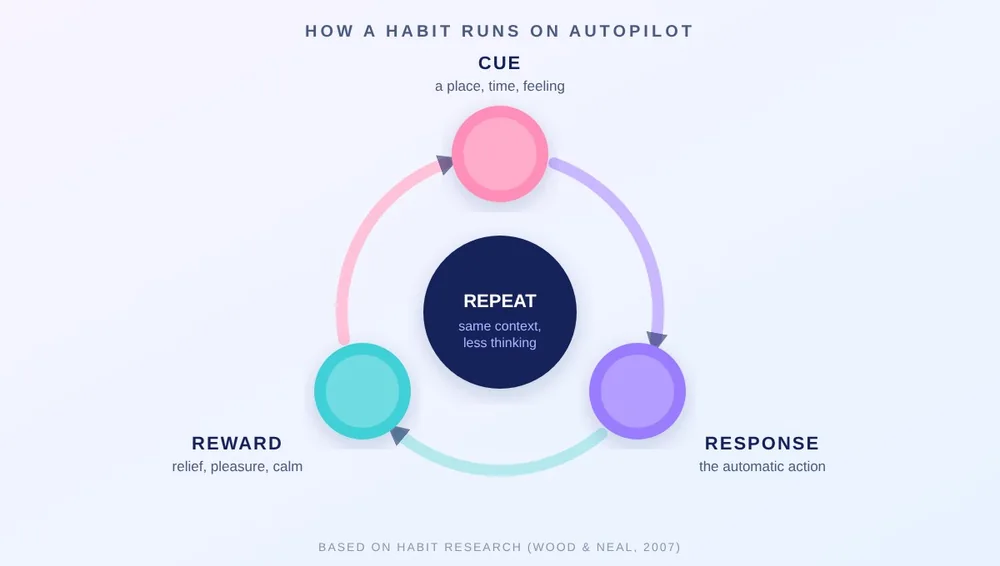
- A habit is a cue, a response and a reward, repeated until the cue alone starts the behaviour.
- Changing someone's intentions changes their behaviour by much less (Webb & Sheeran, 2006).
- What helps: notice the cue, pre-decide with an "if... then" plan, and rehearse the new response.
Most of your day runs on autopilot
In one diary study, about 43% of what people did each day was repeated almost daily in the same setting, often while they were thinking about something else (Wood et al., 2002). The brain automates whatever it repeats, so attention stays free for new problems.
People call this hidden layer the subconscious mind. Psychologists usually describe it as automatic processing, implicit learning and habit.
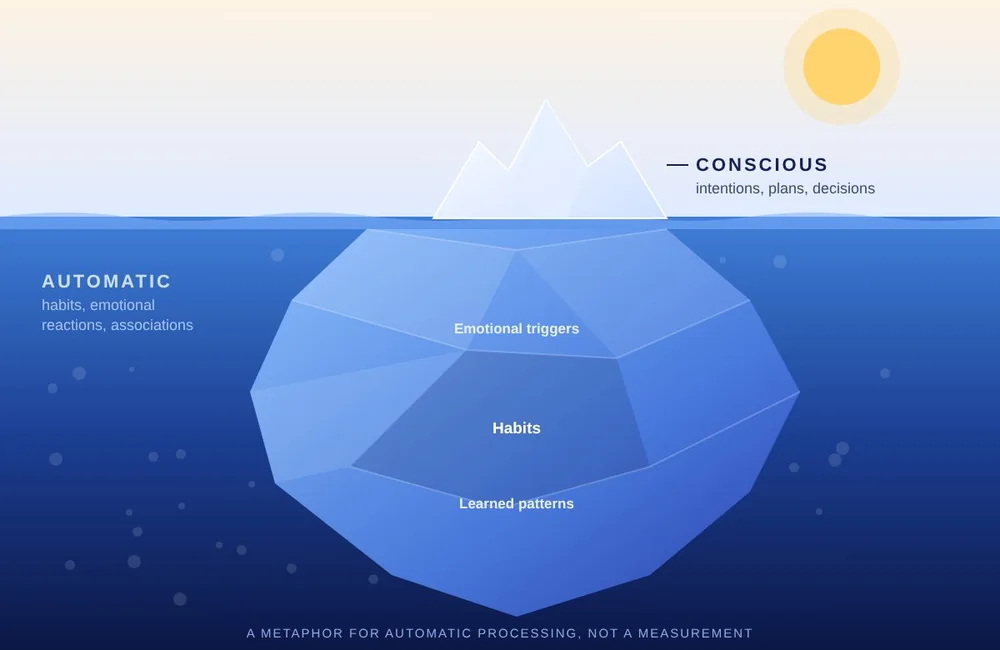
How a habit takes over
A habit forms when the same cue keeps leading to the same response, and that response pays off. With enough repetition the cue alone starts the behaviour. Your goals step back and the context takes over (Wood & Neal, 2007).
This explains a frustrating finding. When researchers succeed in changing people's intentions, behaviour shifts by much less (Webb & Sheeran, 2006). Knowing better and doing better run on different systems.
What helps
Insight alone rarely rewires a habit. Working with the cue does better.
- Notice the cue. What happens just before the pattern starts: a time, a place, a feeling, a person?
- Pre-decide with "if... then". "If I feel the urge to check my phone in bed, then I'll put it on the desk." Plans in this form reliably improve follow-through (Gollwitzer & Sheeran, 2006).
- Rehearse the new response. Repeat it in the same context until it becomes the automatic one.
Try it today (30 seconds)
Think of one moment this week when you reacted in a way you didn't intend. Ask yourself: what came first, a thought, a feeling or a body sensation? Then write one "if... then" sentence for next time.
Where hypnotherapy and NLP fit
Focused attention and suggestion are tools that hypnotherapy works with. Communication, reframing and goal-setting are central to NLP-based coaching. Both are ways of studying how automatic patterns can be noticed and practised differently. Research support varies by technique and use, which is why we teach them with care.
Common questions
Is repeating a habit I dislike a sign of weak willpower?
No. The brain automates whatever it repeats, so the old pattern can start before you have had time to decide anything.
What is the subconscious mind, in psychology?
People use the word for the hidden layer of automatic behaviour. Psychologists usually describe it as automatic processing, implicit learning and habit.
What is an "if... then" plan?
It is a sentence that links a cue to a response you chose in advance, for example "If I feel the urge to check my phone in bed, then I'll put it on the desk." Plans in this form reliably improve follow-through (Gollwitzer & Sheeran, 2006).
Why doesn't insight change a habit by itself?
Because knowing better and doing better run on different systems. Working with the cue does better than insight alone.
References
- Gollwitzer, P. M., & Sheeran, P. (2006). Implementation intentions and goal achievement: A meta-analysis of effects and processes. Advances in Experimental Social Psychology, 38, 69-119.
- Webb, T. L., & Sheeran, P. (2006). Does changing behavioral intentions engender behavior change? A meta-analysis of the experimental evidence. Psychological Bulletin, 132(2), 249-268.
- Wood, W., & Neal, D. T. (2007). A new look at habits and the habit-goal interface. Psychological Review, 114(4), 843-863.
- Wood, W., Quinn, J. M., & Kashy, D. A. (2002). Habits in everyday life: Thought, emotion, and action. Journal of Personality and Social Psychology, 83(6), 1281-1297.
Certificates do not independently confer professional licensure. Illustrations are metaphors, not measurements.